Guide to Fats, Oils, and Grease (FOG)
Ever wonder why it’s actually such a bad idea to put grease down the drain—even with plenty of hot water and soap? Behind every drain lies a complex chemical world where liquid waste transforms into rock-hard blockages.
The Complete Guide to Fats, Oils, and Grease (FOG)
In the world of city infrastructure and food service, few things cause as much damage as FOG. Standing for Fats, Oils, and Grease, FOG is the #1 cause of sewer overflows and expensive plumbing failures worldwide.
Whether you run a food manufacturing plant, work in municipal wastewater, or just want to understand the recent news about "fatbergs," this guide is for you. We explain the lifecycle of fats oil and grease in simple terms
1. The Definitive Guide to Fats, Oils, and Grease (FOG)
In the wastewater and food service industries, the acronym FOG—short for Fats, Oils, and Grease—represents one of the most significant challenges to modern infrastructure. While these substances are essential in food preparation, their presence in municipal sewer systems is a primary cause of environmental damage and costly plumbing failures.
What is FOG?
FOG is a broad category of organic polar compounds derived from vegetable and animal sources. To understand the impact of fats oils and grease, we must categorize them by their physical properties at room temperature:
- Fats: These are typically solid at room temperature (e.g., butter, lard, shortening, and meat trimmings).
- Oils: These remain liquid at room temperature (e.g., vegetable, canola, corn, and olive oils).
- Grease: This usually refers to the fatty byproducts released during the cooking process, such as the drippings from fried meats or the scum found in commercial dishwashers.
The Scale of the Problem
Every year, billions of dollars are spent globally to clear blockages and repair damage caused by improper disposal. For municipalities, FOG is not just a nuisance; it is a structural threat that leads to Sanitary Sewer Overflows (SSOs), which release untreated wastewater into streets, basements, and local waterways.
2. The Science of Sewer Blockages: From Liquid to "Fatberg"
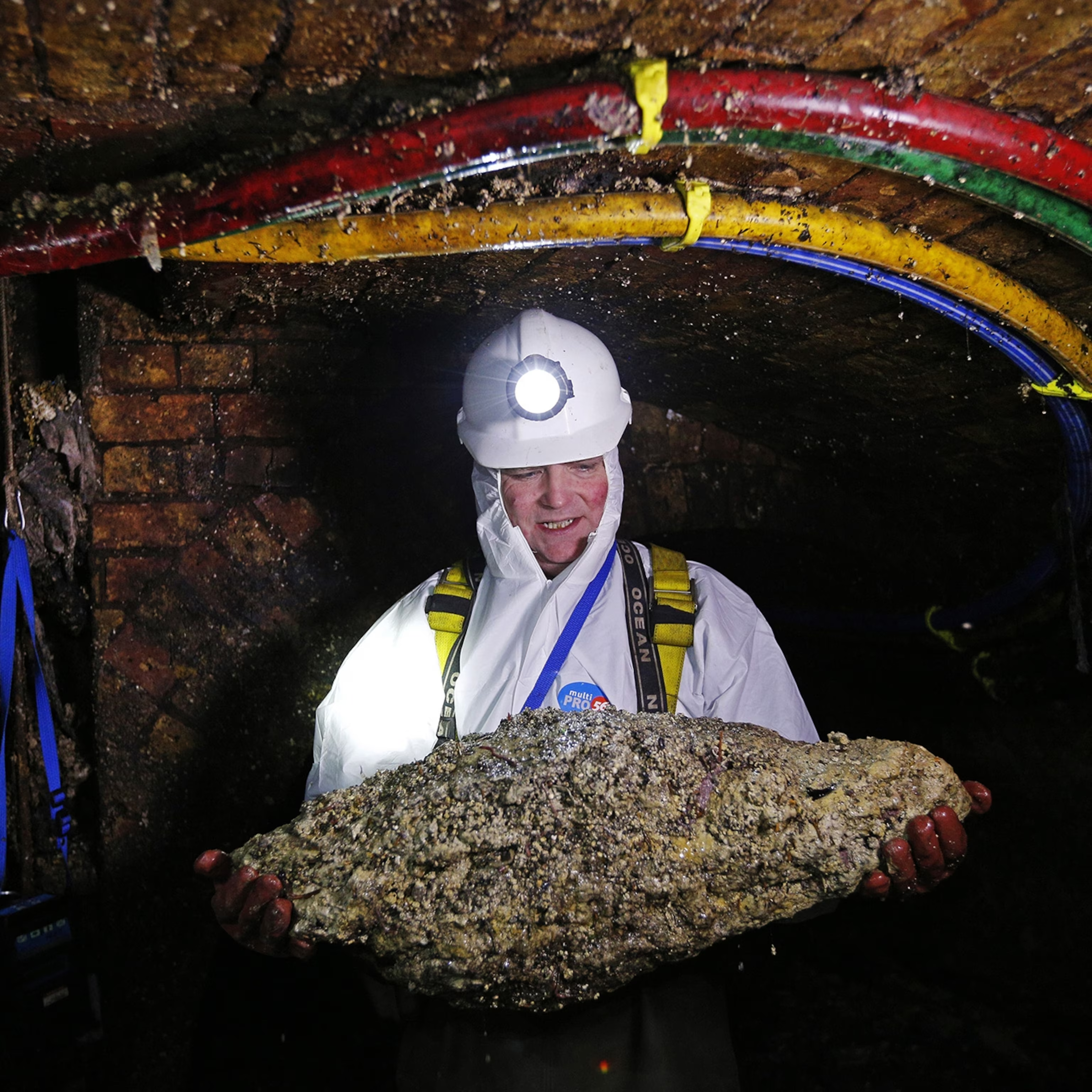
The common misconception is that if you wash fat oil and grease down the drain with hot water and soap, it disappears. In reality, the sewer system acts as a giant chemical reactor that transforms these liquids into a substance as hard as concrete.
The Saponification Process
The primary reason FOG is so destructive is a chemical reaction known as saponification. When fats and oils enter the sewer, they break down into their component parts: glycerol and free fatty acids.
Inside the pipes, these free fatty acids react with calcium—which is naturally present in concrete sewer walls and wastewater. This reaction creates a "calcium soap" (metallic salts). This is not the soft soap you use at home; it is a hard, waxy, and water-insoluble solid that adheres to the interior of the pipe.
The Evolution of a Fatberg
Once the saponified grease attaches to the pipe wall, it begins a "snowball effect":
- Initial Adhesion: A thin layer of hardened grease narrows the pipe diameter.
- Debris Trapping: The sticky surface catches non-biodegradable items like "flushable" wipes, hair, and silt.
- Solidification: Over time, this mixture of grease and trash hardens into a Fatberg.
- Failure: The pipe's capacity is reduced until a total blockage occurs, forcing sewage back up through the nearest exit—often a residential manhole or a business's floor drain.
3. Regulatory Compliance: The 25% Rule and Discharge Limits
For Food Service Establishments (FSEs), managing fats oil and grease is not just a best practice—it is a legal mandate. Municipalities enforce strict regulations to prevent FOG from entering the public sewer main.
The 25% Rule Explained
Most local ordinances utilize the "25% Rule" as the standard for grease interceptor maintenance. This rule states that when the combined depth of the floating grease layer (top) and the settled solids (bottom) exceeds 25% of the total liquid depth of the interceptor, the unit is considered full and must be pumped.
Why 25%?Once an interceptor reaches this threshold, its efficiency drops significantly. The reduced volume causes "short-circuiting," where the wastewater moves too quickly through the tank to allow FOG to separate, leading to downstream clogs and potential fines.
Typical Discharge Limits
While codes vary by city, the common standard for FOG concentration in wastewater discharge is 100 mg/L. Some high-density urban areas may lower this limit to 50 mg/L or even 25 mg/L to protect aging infrastructure.
4. Technical Guide to Fat, Oil, and Grease Testing
Accurate fat oil and grease testing is the only way to verify that a pretreatment system is functioning within legal limits. In the United States, the gold standard for this analysis is EPA Method 1664.
EPA Method 1664: The HEM and SGT-HEM Process
This method uses a gravimetric approach to measure "Hexane Extractable Material" (HEM). Because hexane is a powerful solvent, it effectively dissolves and captures FOG from water samples.
How Testing is Conducted (Step-by-Step)
- Sampling: A 1-liter grab sample is collected in a wide-mouth glass jar and preserved with hydrochloric acid ($HCl$) to a $pH < 2$ to stop biological activity.
- Extraction: In the lab, the sample is mixed with n-hexane. The FOG migrates from the water into the hexane.
- Separation: The hexane layer is separated from the water using a separatory funnel or solid-phase extraction (SPE) disks.
- Evaporation: The hexane is distilled or evaporated off, leaving behind the extracted FOG.
- Gravimetry: The remaining residue is weighed. The result is reported in mg/L.
5. Best Management Practices (BMPs) for FOG
Preventing the accumulation of fats oils and grease is significantly more cost-effective than remediating a blockage or paying municipal fines. For food service establishments, a robust BMP program is the first line of defense.
Kitchen Operational Controls
- The "Dry Wipe" Method: Before washing, scrape all food scraps and solidified grease from pots, pans, and plates into the trash. This simple step can reduce FOG loading in your interceptor by up to 50%.
- Temperature Management: Ensure wash water in pre-rinse sinks does not exceed 140°F. Temperatures above this threshold can emulsify grease, allowing it to bypass your grease trap only to re-congeal further down the sewer line.
- Drain Strainers: Install high-efficiency strainers in all floor drains and sinks to capture organic solids that often carry hidden oils.
Pre-treatment Systems: Traps vs. Interceptors
Choosing the right equipment depends on your flow rate and local plumbing codes.
6. The Circular Economy: Recycling FOG into Biofuel
One of the most significant shifts in fats oils and grease management is the transition from "waste" to "resource." When FOG is collected properly by a licensed hauler, it doesn't just go to a landfill.
From Waste to Energy
Modern rendering plants can process trap grease and used cooking oil (UCO) into Biodiesel.
- Carbon Reduction: Biodiesel produced from recycled FOG can reduce greenhouse gas emissions by up to 80% compared to traditional petroleum diesel.
- Economic Incentive: In many regions, the demand for "brown grease" (trap grease) as a biofuel feedstock is rising, helping to offset the costs of professional grease management services.
7. Frequently Asked Questions (FAQ)
To capture "People Also Ask" (PAA) traffic, we address the most common queries surrounding fats oil and grease.
Q: Can I use chemicals or enzymes to "dissolve" grease in my drains?
A: No. Most municipalities strictly prohibit the use of emulsifiers or biological additives. These chemicals don't remove the grease; they simply push it further down the line where it eventually hardens, potentially making you liable for a mainline sewer blockage.
Q: How often should I perform fat oil and grease testing?
A: Most industrial discharge permits require quarterly testing. However, if you are struggling with compliance, monthly testing can help you determine if your grease interceptor is undersized for your current production volume.
Q: Is "Yellow Grease" the same as "Brown Grease"?
A: No. Yellow Grease is high-quality used fryer oil collected from the kitchen. Brown Grease is the FOG recovered from grease traps and interceptors, which contains more water and impurities. Both can be recycled, but they require different processing methods.

Connect with Our Expert Engineers Today and Find Solutions for Your Wastewater Challenges

